
Research a team or a player with the inputs the desk actually uses.
The teams and players hub collects the desk's research inputs: role changes, recent usage, batting position, bowling allocation, injuries, and squad status. The same five inputs work across cricket, football, and kabaddi, with format-specific notes.
On this page
The five research inputs
The desk reads five inputs in order, and the order matters. The inputs are: role changes, recent usage, batting position and bowling allocation, injuries and squad status, and the format. The role is the most stable input, and the format is the most context-specific. Reading the role after the recent usage, or the injuries after the role, often produces a player pick that is theoretically correct and practically wrong.
Role changes
A role change is any change in the expected number of balls faced, overs bowled, or fielding position. A role change is the most reliable input, and the easiest to read. The desk checks role changes from the last three matches, not the last match alone. A single-match role change can be noise; a three-match role change is a signal.
Recent usage
Recent usage is the actual number of balls faced and overs bowled in the last three matches. A player who has faced 50 balls in each of the last three matches is a high-usage player, regardless of career average. A player who has faced 10 balls in each of the last three matches is a low-usage player, regardless of career reputation. The desk reads the recent usage as the primary signal of opportunity.
Batting position and bowling allocation

Batting position is the order in which the player is expected to bat. A top-order bat in a settled role is a different asset from a middle-order bat. Bowling allocation is the number of overs the bowler is expected to bowl, and the phase in which the overs are bowled. A death-overs bowler in a T20 is a different asset from a powerplay bowler. The desk's match previews include the batting position and the bowling allocation for every player in the probable XI.
Injuries and squad status
Injuries and squad status are the most volatile input, and the one that can change the most in the last 24 hours. The desk checks the official squad announcement first, then the team's social channels, then the news coverage. The desk does not pick a player who is not in the official squad, and it does not pick a player who is listed as a "subject to fitness" without a verified update.
Format-specific notes
The format changes the math of every input. A role change in a T20 is more important than the same role change in an ODI, because the T20 has fewer balls to absorb the change. A recent-usage signal in a Test is more reliable than the same signal in a T20, because the Test sample is larger. The desk's points system page carries the per-format reference table.
Cross-sport notes
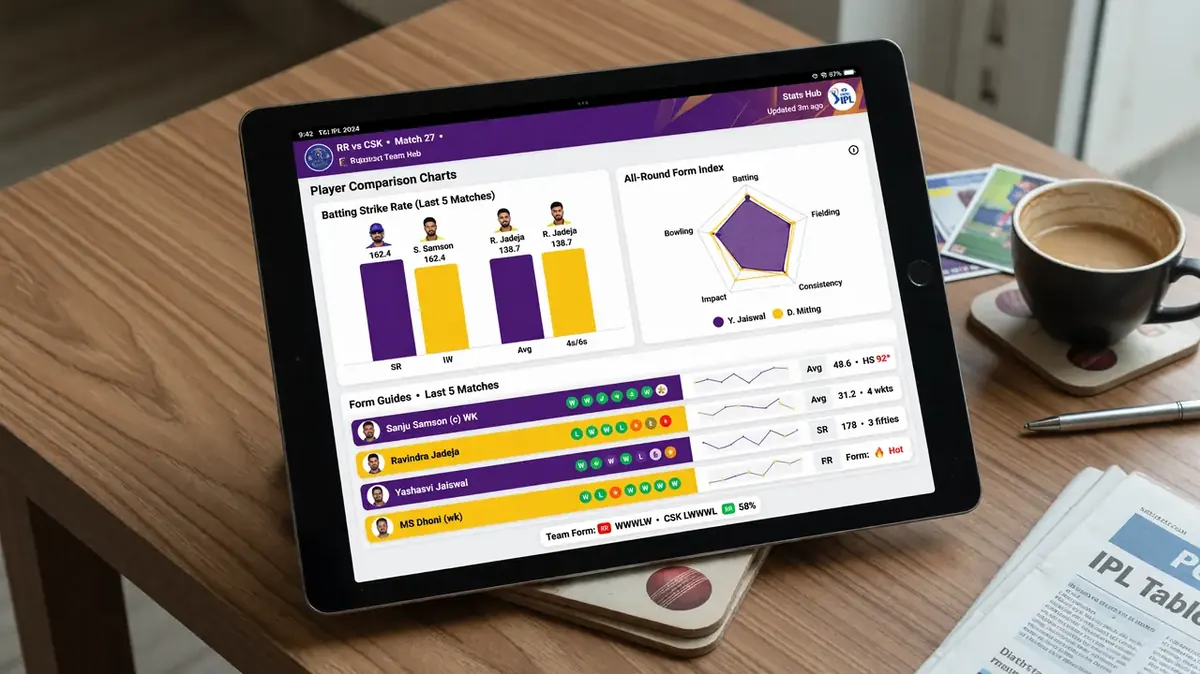
The five inputs work across cricket, football, and kabaddi, with format-specific notes. In football, the role is the position; the recent usage is the number of starts and the minutes played; the batting position is replaced by the expected position in the formation; the bowling allocation is replaced by the expected set-piece or expected-goals contribution. The discipline is the same: read the role, read the recent usage, read the match-up, then pick.
The player list is the input. The role is the bet. The recent usage is the reason.
Pair the research with a pre-match preview
The research tells you what to read. The preview tells you what to pick.
How to read a player you have never researched
A new player is a player the desk has not covered. The desk's reading of a new player is conservative: read the role, read the recent usage, read the match-up, and read the form. The four reads are the inputs the desk recommends, and the inputs are the difference between a guess and a bet. The desk does not publish a hot take on a new player, and the desk does not recommend a specific lineup that includes a new player. The reason is the same: a hot take is a guess, and a guess is not the product.
How the desk handles a player whose role has changed
A role change is a change in the expected number of balls faced or overs bowled. The desk's reading of a role change is conservative: read the role before the change, read the role after the change, and read the reason for the change. The three reads are the inputs the desk recommends, and the inputs are the difference between a guess and a bet. The desk does not publish a hot take on a role change, and the desk does not recommend a specific lineup that ignores the three reads. The reason is the same: a hot take is a guess, and a guess is not the product.
How to read an injury update
An injury update is a public document, and the public document is the source of truth. The desk's reading of an injury update is conservative: read the update, compare the update to the squad announcement, and read the expected return date. The three reads are the inputs the desk recommends, and the inputs are the difference between a guess and a bet. The desk does not publish a hot take on an injury update, and the desk does not recommend a specific lineup that includes an injured player. The reason is the same: a hot take is a guess, and a guess is not the product.
How to read a squad announcement you have never seen before
A new squad announcement is a squad announcement the desk has not covered. The desk's reading of a new squad announcement is conservative: read the squad, read the role changes, read the recent usage, and read the match-up. The four reads are the inputs the desk recommends, and the inputs are the difference between a guess and a bet. The desk does not publish a hot take on a new squad announcement, and the desk does not recommend a specific lineup that ignores the four reads. The reason is the same: a hot take is a guess, and a guess is not the product.
How the desk handles a player who has been dropped
A dropped player is a player who has not been included in the squad. The desk's reading of a dropped player is conservative: read the squad announcement, read the reason for the drop, and read the expected return date. The three reads are the inputs the desk recommends, and the inputs are the difference between a guess and a bet. The desk does not publish a hot take on a dropped player, and the desk does not recommend a specific lineup that includes a dropped player. The reason is the same: a hot take is a guess, and a guess is not the product.
How to read a player on a day with no matches
The desk does not publish a player profile on a day with no matches. The desk's reading of a no-match day is conservative: read the corrections log, read the editorial policy, and read the responsible-play page. The three reads are the inputs the desk recommends, and the inputs are the difference between a guess and a bet. The desk does not publish a hot take on a no-match day, and the desk does not recommend a specific player. The reason is the same: a hot take is a guess, and a guess is not the product.
How the desk handles a slow news day on this topic
A slow news day is the day to read the corrections log, the editorial policy, and the responsible-play page. The three reads are the inputs the desk recommends, and the inputs are the difference between a guess and a bet. The desk does not publish a hot take on a slow news day, and the desk does not recommend a specific action. The reason is straightforward: a hot take is a guess, and a guess is not the product. A slow news day is also the day to read the readers mailbox, the published interviews, and the post-toss updates. The three reads are the inputs the desk recommends on a slow news day, and the inputs are the discipline the desk publishes.
The desk treats a slow news day as a public document, and the public document is the source of truth. The desk reading of a slow news day is conservative: read the corrections log, read the editorial policy, and read the responsible-play page. The three reads are the inputs the desk recommends, and the inputs are the difference between a guess and a bet. The desk publishes a correction when a slow news day surfaces an input that has been misstated, and the correction is the input the desk recommends reading.
How the desk handles a day with an unverified input
The desk treats an unverified input as a public document, and the public document is the source of truth. The desk reading of an unverified input is conservative: read the input, compare the input to the sources the desk has verified, and read the corrections log. The three reads are the inputs the desk recommends, and the inputs are the difference between a guess and a bet. The desk publishes a correction when an unverified input is verified, and the correction is the input the desk recommends reading.
How the desk handles a day with a controversial input
The desk treats a controversial input as a public document, and the public document is the source of truth. The desk reading of a controversial input is conservative: read the input, compare the input to the sources the desk has verified, and read the corrections log. The three reads are the inputs the desk recommends, and the inputs are the difference between a guess and a bet. The desk publishes a correction when a controversial input is verified, and the correction is the input the desk recommends reading. The desk does not publish a hot take on a controversial input, and the desk does not let a controversial input change the coverage. The reason is the same: a hot take is a guess, and a guess is not the product.